
Milk and its products too were less expensive with inflation print of 4.21 per cent, cereals and products at 2.10 per cent, meat & fish at 3.31 per cent while for eggs the prices grew at a slower pace of 8.51 per cent.
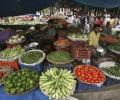
The pace of retail price rise in January 2016 is the highest since 6.46 per cent in September 2014.

Recalibrating data of past years using 2011-12 as the base year instead of 2004-05, the Central Statistics Office estimated that India's GDP grew by 8.5% in the financial year 2010-11 and not at 10.3% as previously estimated.

Retail inflation eased to an 11-month low of 4.83 per cent in April as prices of some kitchen items declined though overall food basket firmed up marginally, according to a government data released on Monday. The Consumer Price Index (CPI)-based retail inflation was 4.85 per cent in March. It was 4.7 per cent in April 2023.

The technical report of the NSSO has generated controversy following its observation that as much as 36 per cent units forming part of MCA-21 database, used in computing GDP, could not be either identifiable or traceable in the field.

In the first quarter of FY14, real GDP growth estimated by the Central Statistics Office stood at 4.4 per cent on a factor cost basis, and at 2.4 per cent on a market price basis, the IMF said.

The final Budget for the fiscal is likely to be tabled in July after formation of the new government.

In a paper, EAC-PM accused Subramanian of "cherry-picking high-frequency indicators" to express his skepticism about the growth rates after 2011-12.

In terms of industries, 16 out of 23 industry groups in the manufacturing sector have shown positive growth during December 2017 as compared to the same month year ago.

Factory output as measured in terms of IIP had grown by 7.3 per cent in December 2017.

In terms of industries, 10 out of 23 industry groups in the manufacturing sector showed positive growth during November 2018.

Indian economy is witnessing stable growth momentum, says OECD.
Retail inflation declined to a one-year low of 5.72 per cent in December 2022, mainly due to softening prices of food items, according to official data released on Thursday. The Consumer Price Index (CPI) based retail inflation was at 5.88 per cent in November 2022 and 5.66 per cent in December 2021.

In terms of industries, 22 out of 23 industry groups in the manufacturing sector showed positive growth during July 2018.

RBI Governor Raghuram Rajan has noted the contradiction.

In a double delight, retail inflation eased to a one-year low of 5.72 per cent - staying below the upper tolerance limit for two months in a row, while factory output rose sharply to 7.2 per cent on the back of healthy growth in manufacturing. The retail inflation numbers based on Consumer Price Index (CPI) will provide some room for the Reserve Bank to further moderate the quantum of hike in key interest rate or even press a pause button. The RBI has been on a rate hiking spree since May 2022 in its bid to tame inflation, having raised the repo rate by a cumulative 225 basis points (bps).

The previous low at 1.8 per cent was recorded in October 2017.
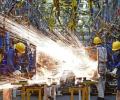
Capital goods output rose by a robust 20 per cent in the month under review as against a contraction of 2.4 per cent earlier.

Rajan had said that there was lack of clarity about the new method.
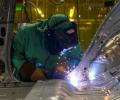
The manufacturing sector, which constitutes 77.63 per cent of the IIP, contracted by 0.4 per cent in March as compared to 5.7 per cent expansion in the year-ago month.

The previous high was recorded at 7.5 per cent in the July-September quarter of 2016-17.

Retail inflation rose to three-month high of 4.81 per cent in June, mainly on account of hardening prices of food, according to the government data. Inflation based on the Consumer Price Index (CPI) stood at 4.31 per per (revised upward from 4.25 per cent) in May and 7 per cent in June 2022. The inflation, however, remains within the RBI's comfort level of below 6 per cent.

Fruits, vegetables and eggs continued to witness deflationary trend during January this year, with their prices declining 4.18 per cent, 13.32 per cent and 2.44 per cent, respectively.

The inflation in the food basket spiked to 7.89 per cent in October 2019 as against 5.11 per cent the preceding month.

The CSO said that the first revised estimates for 2016-17 have been compiled using industry-wise/institution-wise detailed information instead of using the benchmark-indicator method employed at the time of release of Provisional Estimates on May 31, 2017.

The country's demographic dividend is dissipating, with seriously adverse consequences for young India, asserts Shankar Acharya, former Chief Economic Adviser to the Government of India.

Output of capital goods -- a proxy for infrastructure investments in the country -- contracted 1 per cent in July
India's annual industrial output growth slowed to 4.2 per cent in July compared with an upwardly revised 4.4 per cent growth a month ago, government data showed on Friday.

The NSE index Nifty ended above the 10,500-mark.
.jpg)
Chidambaram said he was particularly happy that agriculture growth has been estimated at 4.6 per cent for 2013-14.
Brokerage house Nomura today said the downward revision of FY'13 growth figure by the Central Statistics Office will have a positive base effect for GDP expansion in the current fiscal.

Central Statistics Office has come out with GVA to measure growth.

Top Sensex gainers include Hero MotoCorp, Bajaj Auto, Asian Paints, IndusInd Bank, HUL, and Maruti, rallying up to 5.87 per cent. While, ICICI Bank, NTPC and ITC slipped up to 0.13 per cent.
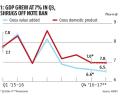
It is difficult to reconcile the GDP numbers with other economic indicators.

The Indian economy appears to have slowed down in 2018-19 due to lower private consumption, tepid growth in fixed investment and muted exports, a finance ministry report has said.

Remonetisation exercise will eliminate cash squeeze by April 2017

The GDP has been estimated at Rs 126.54 lakh-crore (Rs 126.54 trillion).
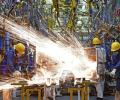
Capital goods, a barometer of investments, showed a sharp increase in output by 14.6 per cent in January, 2018 as against a decline of 0.6 per cent year ago.

The rate of price rise was at 6.77 per cent in June last year.

Indian economy's growth is expected to be "below trend" even as neighbouring China and most of the developed nations are expected to see better prospects, according to Paris-based think tank OECD.
